UPI MDR from 15 October 2026: What the New 0.4% Charge Really Means for Your Business
Your WhatsApp is probably full of it: "UPI ab free nahi raha — 15 October se charge lagega." Half of it is panic, and half of it is a real change every business owner should understand. Let me give you the straight version, founder to founder — what actually changed, who pays, who is safe, and the one part most people are getting wrong.
What actually changed on 15 September 2026
The government and the National Payments Corporation of India (NPCI) announced a new funding model for UPI. From 15 October 2026, a 0.4% Merchant Discount Rate (MDR) applies to eligible person-to-merchant (P2M) UPI transactions above ₹2,000. The fee is capped at ₹300 for a single transaction of ₹75,000 or more.
This is a shift. Until now, UPI carried zero MDR. The Ministry of Finance notification (S.O. 5067(E), dated 14 September 2026) explicitly protects UPI and RuPay payments up to ₹2,000 from any charge, and the framework keeps the fee on the merchant side — not on you, the person paying.
Who pays — and who doesn't
This is where the panic messages fall apart. Here is what the NPCI FAQ actually says:
- Customers: You are not charged directly. Your bill cannot have the MDR added to it as a line item — that is not allowed. UPI apps also cannot slip in a platform fee.
- Person-to-person (P2P) transfers: Free, no matter the amount. Sending ₹10,000 to a friend or moving money between your own accounts stays free.
- Any payment up to ₹2,000: Free for the merchant too. Per the government, these account for more than 95% of all merchant UPI transactions.
- Larger merchants, on payments above ₹2,000: They pay the 0.4% MDR.
- Small merchants (P2PM): Exempt — see the next section.
Small shops are protected — here's the exact rule
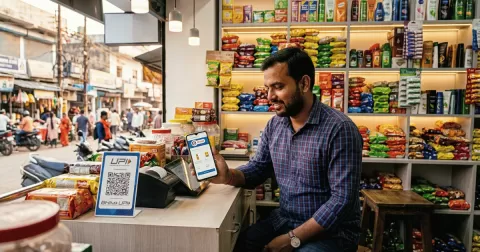
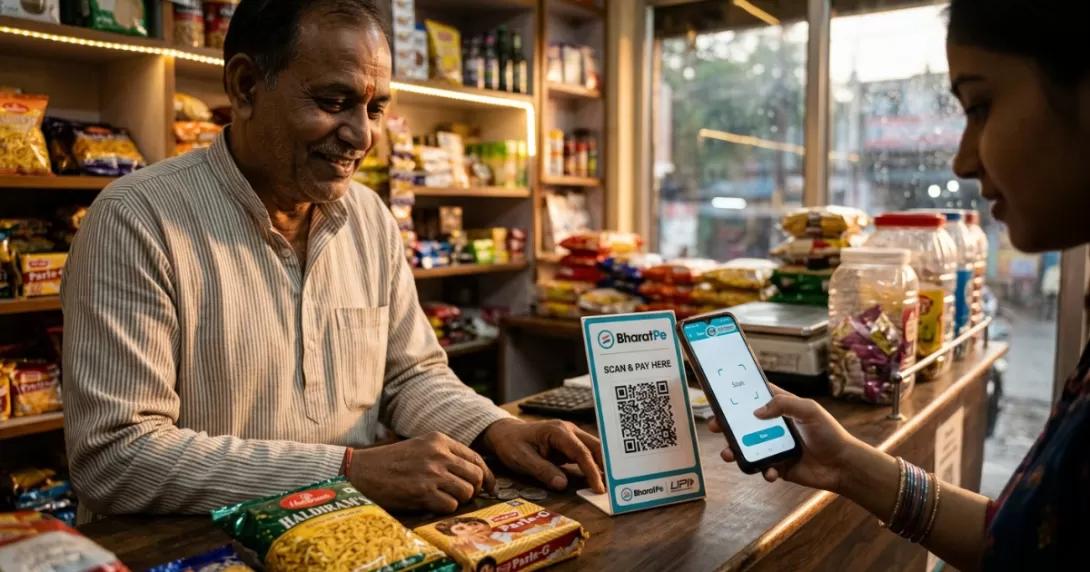
If you are a small vendor receiving UPI QR payments directly into your own bank account under the P2PM category, and your monthly UPI QR receipts stay up to ₹1 lakh, you continue to pay zero MDR. Two things worth repeating, because shopkeepers keep asking:
- You do not need a new QR code, and you do not need GST registration for this exemption.
- A single customer paying you ₹3,000 does not suddenly make you liable. Your account category and monthly volume decide it — not one big payment.
The catch: if your inward UPI credits cross ₹1 lakh a month for three consecutive months, your bank moves you from P2PM to the regular P2M category. After that, the 0.4% applies to your payments above ₹2,000. So growth has a small cost attached — worth planning for, not fearing.
The honest part nobody's saying
Here is the bit the "relax, it's free" takes skip. For a larger merchant who now pays 0.4% on big-ticket sales, that cost does not vanish into thin air. Like any business input cost — rent, packaging, a card machine — it gets absorbed into margins or slowly worked into prices over time. You won't see a "UPI charge" on your receipt, but on higher-value purchases a sliver can eventually reach the customer's pocket, the same way every cost does.
You may also see behaviour change: some merchants gently nudging you toward cash, or splitting a ₹4,000 bill into two under-₹2,000 payments. Both are worth understanding — though deliberately splitting to dodge the fee is exactly the kind of pattern banks will watch.
For the vast majority of small Jharkhand businesses under the ₹1 lakh exemption, there is genuinely nothing to pass on. The pinch is real only at the larger, high-value end.
The numbers, in plain rupees
| Payment received by merchant | MDR (who pays: the merchant) |
|---|---|
| Up to ₹2,000 | ₹0 |
| ₹3,000 | ₹12 (0.4%) |
| ₹50,000 | ₹200 (0.4%) |
| ₹75,000 and above | ₹300 (capped) |
| Small P2PM shop (≤₹1 lakh/month) | ₹0 — exempt |
| Essential sectors above ₹2,000 (fuel, telecom, insurance, railways, agri) | ₹5 flat |
| Capital market (mutual funds, brokers) | 0.02%, capped ₹300 |
Source: NPCI FAQ and the Ministry of Finance notification, 15 September 2026.
What this means for a Ranchi or Jharkhand business
Most of what we see in Ranchi, Jamshedpur and Dhanbad — the kirana store, the chai stall, the salon, the tuition class, the small kitchen taking orders on WhatsApp — sits comfortably under ₹1 lakh a month in UPI receipts. For them, 15 October changes nothing. Keep accepting payments as usual.
The businesses that should pay attention are the growing ones: the appliance dealer, the clinic, the coaching institute, the wholesaler, the builder taking ₹20,000–₹50,000 payments. If you are near or past ₹1 lakh a month, this is the moment to look at your pricing and your billing, not to panic-forward a rumour.
A 6-point checklist for business owners
- Check your monthly UPI inflow. Open your bank/UPI app and look at the last three months of UPI QR receipts. Are you under ₹1 lakh, or crossing it?
- Know your category. Ask your bank or payment provider whether your account is P2PM (exempt) or P2M. This one answer decides everything.
- Do not add the charge to a customer's bill. It is not permitted, and it damages trust. If you are a larger merchant, absorb it or factor it into your base price instead.
- Don't game the ₹2,000 limit. Splitting bills or juggling QR codes to stay "small" is a pattern banks can flag — not worth the risk.
- Keep clean records. If you are crossing into P2M, proper billing and reporting matter more than ever. Good billing or ERP software pays for itself here — see how we build custom software and ERP for MSMEs.
- Take payments where they convert. If your customers pay you over WhatsApp or your website, make that flow clean and professional — that's what our web development work is for.
Frequently asked questions
Will I, as a customer, pay UPI charges now?
No — not directly. Your payments stay free, the charge cannot be added to your bill, and P2P transfers and payments up to ₹2,000 remain free regardless. The MDR is a merchant-side fee.
Is my small shop going to be charged?
If you receive up to ₹1 lakh a month via UPI QR under the P2PM category, no — you are exempt. You only move into the chargeable category if you cross ₹1 lakh a month for three straight months.
Do I need GST or a new QR code because of this?
No. The exemption for small merchants does not require GST registration, and your existing QR codes and soundboxes keep working.
How much is the MDR on a ₹5,000 payment?
For a chargeable P2M merchant, 0.4% of ₹5,000 is ₹20 — paid by the merchant, not the customer. On ₹75,000 or more, the fee is capped at ₹300.
When does this start?
15 October 2026, per the NPCI framework announced on 15 September 2026.
Confused about where your business fits?
If you're not sure whether you're P2PM or P2M, how to set up billing that stays clean past ₹1 lakh a month, or how to take payments professionally on your site or WhatsApp — let's talk it through. Book a free 15-minute consultation, no sales pressure.
📲 WhatsApp +91 91026 01040 · Contact S K Tiwari · more straight-talk guides on our blog