Your hottest B2B lead just messaged you on WhatsApp at 9:47 PM. By the time someone on your team opens it the next afternoon, they've already shortlisted two of your competitors. That single delay is the most expensive leak in Indian B2B sales right now — and it is entirely fixable.
If you run a startup or an MSME, WhatsApp is already where your buyers talk. The real question is whether your pipeline runs on it or merely reacts to it. The moment you decide to automate WhatsApp lead generation, that chaotic inbox becomes a predictable, qualified flow.
The right setup is part workflow and part custom software and AI solutions— engineered around how your sales team actually works, not a generic off-the-shelf bot.
Why manual WhatsApp follow-up is quietly killing your pipeline
Indian buyers expect a WhatsApp reply in minutes, not business hours. Speed-to-lead is the metric, and most teams lose on it without realising. The lead that gets a reply in five minutes converts at a multiple of the one that waits till tomorrow.
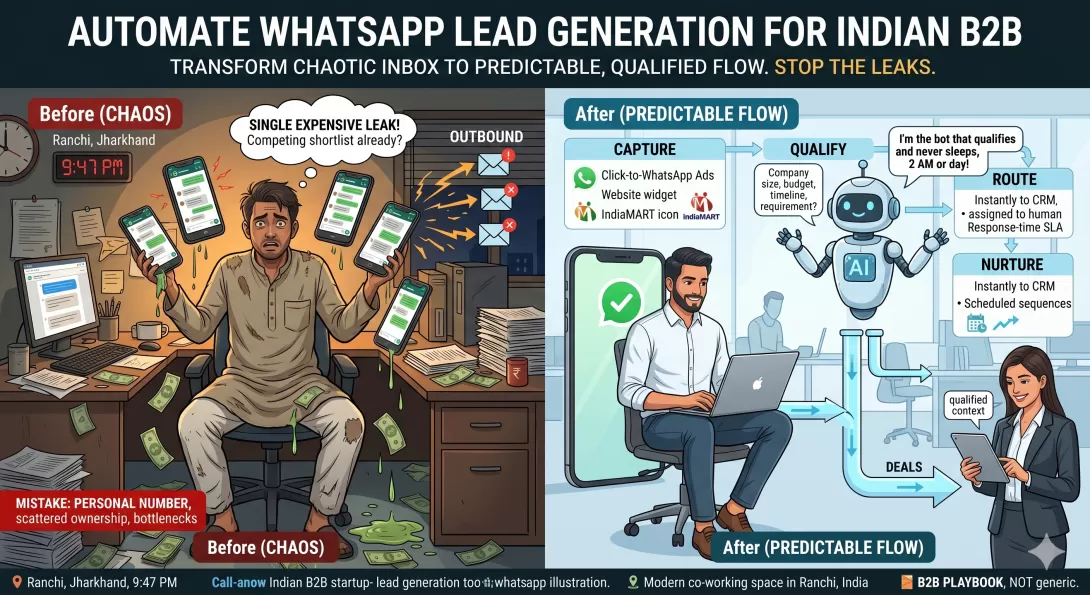
The deeper problem is structural. Enquiries land on personal numbers, scattered across three salespeople's phones, with no tracking and no clear ownership. When everyone owns the lead, nobody does.
And it bottlenecks at the top. The founder ends up qualifying every enquiry personally — which does not scale past a handful of leads a day.
What "automating WhatsApp lead generation" actually means
Let me be blunt about what it is not. It is not buying a list of numbers and blasting cold marketing messages — that gets your number flagged and your business account banned. Automation done right is compliant by design.
What it actually means is closing the loop across four stages, with no human babysitting the early ones:
- Capture — every enquiry, from every source, lands in one system.
- Qualify — a bot asks the 4–5 questions that separate a real buyer from a tyre-kicker.
- Route — the qualified lead is assigned to the right person instantly, with full context.
- Nurture — the ones not ready today get sequenced follow-ups instead of being forgotten.
The building blocks of an automated WhatsApp lead engine
Start with the WhatsApp Business API, not the consumer app
The green consumer app and even the WhatsApp Business app do not scale. No proper automation, no multiple agents on one number, and bulk outreach through them violates WhatsApp's terms.
You need the WhatsApp Business API, accessed through a verified Business Solution Provider (BSP). This is what unlocks bots, CRM integration, multi-agent routing, and approved message templates. It also enforces opt-in, which keeps you on the right side of policy.
Click-to-WhatsApp ads for the top of the funnel
These are Meta ads on Facebook and Instagram that open a WhatsApp chat instead of sending traffic to a landing page. A customer-initiated chat opens a 24-hour service window — and replies inside that window are free.
Structure your spend around driving inbound intent, not outbound blasts. Inbound is cheaper, warmer, and far more compliant.
A qualification bot that handles the boring first five minutes
The bot's job is not to close. Its job is to respond instantly, capture name, company, requirement, budget and timeline, and never let a lead sit unattended. It does the work no salesperson enjoys, at 2 AM, without complaint.
CRM and routing so nothing falls through
Every qualified conversation should push into your CRM, get an owner assigned, and trigger an alert to that person. A response-time SLA on top of this turns "we'll get to it" into a measurable commitment.
How to set it up, step by step
- Get a verified WhatsApp Business API number through a reputable BSP. Budget a few days for Meta's business verification.
- Define your qualifying questions — the four or five that genuinely predict a B2B fit for your business.
- Build the conversation flow: instant greeting, qualification, and a clean handoff to a human.
- Connect your entry points — a website chat widget, a QR code on collateral, and click-to-WhatsApp ads.
- Wire the flow into your CRM with owner assignment, alerts, and human handoff for qualified leads.
- Pre-approve your message templates and set up utility-category nurture sequences for leads who aren't ready yet.
- Track the numbers that matter — response time, percentage qualified, and lead-to-deal conversion — then tighten the flow monthly.
What it actually costs in 2026
This is the first question every founder asks, so here is the honest version. Meta now bills on a per-message model, not the old per-conversation window. Messages fall into four categories, and the category sets the price.
- Marketing — the priciest, around ₹0.86 per message in India.
- Utility and Authentication — far cheaper, roughly ₹0.11–0.15 per message.
- Service — replies within a customer-initiated 24-hour window are free.
Two costs sit on top of Meta's rates: your BSP's platform fee plus any per-message markup, and 18% GST. Treat published rates as a starting point and confirm the current rate card with your BSP before you commit.
The strategic takeaway is simple. Drive inbound conversations into the free service window, classify your templates correctly, and your effective cost per qualified lead stays low. Outbound marketing blasts are where budgets quietly bleed.
Mistakes that get your number flagged — or your pipeline ignored
- Scraping or buying numbers and messaging them without opt-in. This is the fastest route to a ban.
- Treating WhatsApp like an email blast. The channel is personal, and buyers punish noise.
- Filing marketing content under a utility template to save money. Meta will catch the misclassification.
- Building a bot with no human handoff, so a hot lead hits a dead end.
- Ignoring the 24-hour service window and paying for messages you could have sent free.
Why B2B needs a different playbook from B2C
B2B sales cycles are long and involve several stakeholders, so instant-purchase tactics don't apply. The goal of automation here is qualification and nurture, not a checkout.
That means scoring leads on fit rather than chasing raw volume. Ten warm, qualified buyers will always beat a thousand cold numbers.
The division of labour is the whole point: the bot qualifies and never sleeps, and your people spend their hours only on conversations worth closing.
Map your lead flow with us
If your WhatsApp is already busy but your pipeline isn't, the gap is almost always architecture — not effort. The fix is a system designed around your sales process, your CRM, and your buyers.
Map your lead flow with us
If your WhatsApp is already busy but your pipeline isn't, the gap is almost always architecture — not effort. Book a free 30-minute scoping session and we'll show you exactly where the leaks are.